




Data Without Worldview is Meaningless
There’s a comfortable story being told about artificial intelligence right now. The machine handles the thinking, the human signs off, and the work gets faster and cheaper without losing anything that mattered. It’s a nice story. It’s also wrong, and the businesses that believe this will spend the next decade producing forgettable work while wondering why their market share keeps slowly leaking to someone else.
I want to make the opposite case. Not that AI is dangerous or overhyped, but a more specific argument. AI is a backwards-looking instrument, and innovation is a forwards-looking act. The gap between those two facts is exactly where human judgement lives, and it’s the only place real competitive advantage can be created. But if you close that gap by handing it to the machine, you get the average.
In a market, the average is death by a thousand competitors who all have the same tool.
This isn’t an argument against using AI. The last companies to adopt it will die first. The argument is about how you should think about its use, and what you must refuse to outsource if you want the work to be worth anything.
The instrument is a rear-view mirror
Let’s start with what the tool actually is, because most of the confusion downstream comes from getting this wrong. An LLM alone doesn’t retrieve facts, and it doesn’t reason towards truth. It calculates the statistically probable next fragment of text, based on the enormous corpus it has ingested. That dataset is, by definition, a record of what has already been written, decided, and done.
That word “alone” is doing some work here. In practice the raw model rarely operates by itself anymore. We bolt things onto it. Retrieval systems that ground it in our own documents, web access that pulls in this morning’s news, coding agents that act on a live codebase, tools that let it run an analysis and call other software. This is the harness, and it’s important to bring up. It widens what the model can reach and lets it do things, not only say them.
But look at what every one of those additions has in common. Retrieval fetches what has already been written. The agent recombines methods that already exist. Web search returns pages someone has already published. Being able to call certain tools makes the instrument more powerful and a great deal more current, yet it leaves the nature of the thing untouched. You have built a bigger, sharper rear-view mirror. You haven’t built a windscreen. Many people are just typing into a bare chat window and taking the first fluent answer it offers.
All of this makes AI extraordinary at a particular task: Compressing and synthesising the past. Feed it a thousand interview transcripts, a decade of competitor filings, an industry’s worth of patents, and it will map the structure of that material faster than any team of analysts. It can even force collisions between domains, applying the logic of one industry to the problems of another. Something a human siloed in one sector would never see. That’s genuine value, and we should use it relentlessly!
But every one of those outputs is a statement about what has been. None of it is a statement about what should be next. The model has no stake in the future, no theory of where the market is heading, no conviction about which of the ten thousand possibilities is the one worth betting the business on. It can’t tell you that, because the future isn’t in the training data. The future, or more, a bet on the future is based on the argument you make and the conviction you have.
Worldview is the foundation for that argument. It’s the set of assumptions, convictions, and bets a person or a business holds about how the world works and where it is going. Data is meaningless without it! The same competitor analysis, handed to two businesses with different worldviews likely produces two different strategies, both of which could be right for that business based on their worldview. Strip the worldview out and the data doesn’t become neutral and objective. It becomes meaningless, because there’s no longer anyone deciding what it’s for. If the two businesses outsource the thinking to AI, they are likely to apply a backwards looking strategy aligned to the average. No differentiation.
Why the average is fatal
If a model’s output is the statistical centre of everything written on a subject, then every business prompting the same model with the same kind of question is being pulled towards the same centre. The tool is, structurally, a machine for producing consensus. And consensus is the precise opposite of what innovation requires.
This is no longer a theoretical worry. In March 2026, researchers led by the Esade Business School in Barcelona, published work in the Harvard Business Review that put numbers on it. [1] Across more than 15,000 trials spanning seven flagship models (including ChatGPT, Claude, Gemini, and Grok), the models recommended differentiation over cost leadership ~96% of the time and human augmentation over automation ~93% of the time, regardless of the business scenario they were handed. The researchers named the phenomenon “trendslop”, the tendency of models to recommend whatever aligns with current corporate buzzword trends found in their corpus rather than the logic of the specific situation.
The most damning part of which, is what they found about prompting. The industry’s standard defence is that a bad answer means a weak prompt. Rubbish in, rubbish out. While this does hold some truth, the data from this study doesn’t support this. Reversing option order, adding rich organisational context, offering the model incentives, these moved the bias only marginally, and the largest shifts looked more like a quirk of how the options were ordered rather than genuine reasoning. The bias isn’t a surface problem you can engineer away. It’s baked into a system whose entire job is to find the centre of the distribution.
Sit with that consequence for a moment.
If every company in a sector outsources its strategic direction to the same handful of models, every business converges on the same answer. You don’t end up with a market of differentiated competitors. You don’t end up with a new innovative strategy or product. You end up with one strategy wearing a dozen logos. The irony of this is that the models keep recommending “differentiation” while being the most powerful homogenising force ever introduced into business thinking! They tell you to stand out while quietly marching everyone into the same queue.
The doorman fallacy, and the trouble with “human in the loop”
The defenders of the comfortable story have a phrase ready. “Human in the loop”. Keep a person in the process to check the output, and the worry dissolves. I think this phrase is doing real damage, and it’s worth being precise about why.
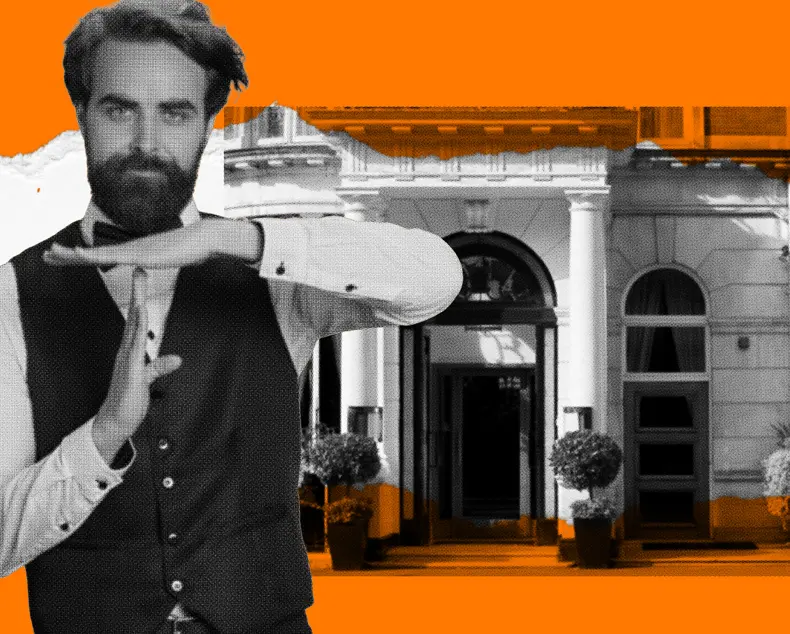
Rory Sutherland, in “Alchemy”, describes what he calls the doorman fallacy. [2] Define a hotel doorman’s job narrowly as “opening the door”, and automation looks obvious. Install a mechanism (in this case a revolving door), save the salary, congratulate yourself. But opening the door was never the job! The doorman hails taxis, recognises returning guests, deters trouble, reads the mood of an arrival, and signals the status of the establishment simply by standing there, just to name a few. By defining a role by its most visible task, you destroy all the value you couldn’t be bothered to measure. You misvalue the human and call it efficiency.
“Human in the loop” is the doorman fallacy applied to thinking. It prescribes the human role at its most basic. A checkpoint, a rubber stamp, a quality gate on the end of a machine process. It assumes that the valuable work is the synthesis the AI did, and that the human is there to catch errors. This inverts the actual order of importance. The synthesis is the cheap part. The worldview, that is, deciding what question to ask, what the output is for, which probable answer to bet on, what the data is blind to, that’s the part that can’t be automated and the part that creates the advantage. Putting the human “in the loop” frames the most important contributor as a safety feature.
The honest framing is the reverse. The AI is in the human’s loop. The human holds the worldview, sets the direction, owns the bet, and uses the machine as an instrument inside a process the human governs. To be clear, this isn’t about being pedantic about word order. It decides where you put your best people and what you expect of them. Treat your strategists as loop-checkers and they’ll behave like loop-checkers. Your innovation will have exactly the originality of a process designed to catch typos.
Technology keeps the function and discards what mattered
There is a much larger pattern here too, and AI is only its latest instance. Technology has a habit of decoupling things that used to come bundled together, usually delivering the headline function while quietly discarding everything that travelled alongside it.
The clock decoupled timekeeping from the sun. GPS decoupled arriving somewhere from knowing where you are. Recorded music decoupled the song from the musician in the room. Photography decoupled the face from the body, the telephone the voice from the person. Google decoupled the answer from the expert who used to hold it. In each case the headline function survived and often improved. And in each case, something less measurable and frequently more valuable was severed and left behind.
AI is now performing this operation on thinking itself. It decouples the output from the act of reasoning that used to produce it. You get the memo, the analysis, the strategy, without having gone through the cognitive work that the memo used to be evidence of. And as with the doorman, the danger is that the discarded part (the reasoning, the wrestling with the problem, the worldview formed in the struggle) was the part that actually mattered.
This was directly seen in a 2025 University of Pennsylvania study where nearly a thousand high school students using ChatGPT completed 48% more practice problems correctly, yet, once that access was taken away, scored 17% lower on independent exams than those who never had it. [3]
This is also where the standard productivity case contradicts itself. You may end up with more time to be creative while having dismantled the very conditions under which creativity happens! A business that has outsourced its thinking hasn’t freed its people to think more deeply. It has removed the occasions on which they used to think at all.
There is an obvious objection here, and it’s worth meeting head on. Every one of those technologies offloaded something too, and we came through this completely intact. We handed the calculator our arithmetic and lost little worth keeping. So why should thinking be any different? Because what gets offloaded this time is the very thing that all the freed-up capacity was meant to make room for. Judgement never lived in the arithmetic. It lives in the reasoning, and strategic reasoning is the act that builds a worldview in the first place. Hand it to the machine and you have pulled out the one muscle the whole business was standing on. The freed-up hours were supposed to go on thinking more deeply. In practice they buy a business that has lost its ability to think at all.
One decoupling deserves singling out, because it points at something innovation depends on, yet is quite unassuming at first glance.
Consider asking a sommelier to recommend a wine. The functional need (a wine that suits the meal) is real, and an AI can now meet it instantly. But the request was never only functional. It opened a low-stakes, socially legitimate channel between two strangers. The need was a pretext, and the pretext was the bridge. Remove the need by satisfying it privately through a machine, and the bridge goes with it. What is left is a stark choice between total isolation and high-effort emotional vulnerability, with nothing easy in between.
The link to innovation is direct, even if it is rarely stated. Ideas don’t arrive fully formed from a database. They emerge from collision and compromise between people. The offhand remark, the question asked of someone in a different field, the conversation that began as a transaction and wandered somewhere useful. Strip out the low-friction human contact and you lose more than just pleasantness. You lose the informal network through which worldviews are exchanged, challenged, and sharpened. A business whose people only ever query a machine has cut itself off from the messy human traffic that real insight tends to travel on. Thinking slow is where unusual connections happen.
Unlimited ideas, vanishing conviction
Nietzsche diagnosed something similar more than a century ago, and the diagnosis has aged into an uncomfortable relevance. What was his point? A warning that when the shared horizons a society organises itself around dissolve, what follows isn’t automatic liberation but disorientation. Remove the framework that told people what mattered, and you don’t get a population of confident free spirits. You risk what he called the “last man”. Comfortable, frictionless, risk-averse, and aspiring to nothing.
We can also see this in the concept of the “paradox of choice” by the psychologist Barry Schwartz, who argued that an excess of options produces not freedom, but anxiety and paralysis.[4]
These two thoughts compound, and AI sits at their intersection. AI has thrown the doors open on ideas. Generating a hundred plausible concepts is now a trivial thing. The constraint that used to discipline us, that good ideas were scarce and hard-won, is gone. We have inverted the problem. We once had a few good ideas and deep knowledge of how to execute them. Now we have unlimited ideas and a thinning bench of people who know how to convert one of them into something real.
For innovation this is the whole point. The bottleneck wasn’t the act of idea generation, and AI’s gift at divergence doesn’t solve the thing that was actually hard. The hard part is conviction! The worldview that lets you stare at a hundred probable options and bet the business on one of them for reasons you can defend. That is precisely the capacity Nietzsche feared we would let atrophy and Schwartz showed we struggle to exercise. Hand the final choice to the model and you’ve not escaped the paralysis. You’ve laundered it into a recommendation that, as the trendslop data shows, is just the consensus in a confident voice.
How to actually use AI: Divergence yes, conviction never
Use AI for what it’s genuinely best at, which is divergence and synthesis. Let it parse the unstructured mess, map the competitor landscape, force collisions between your sector and unrelated ones, and generate a high volume of raw concepts without regard for feasibility. This is where its backwards-looking nature is a strength. It’s read more of the past than you ever could, and it can recombine it at speed.
Then stop.
The trendslop researchers reached the same conclusion from their data. Restrict the models to generating options and ban them from making the final selection. Convergence (choosing, ranking, killing concepts, and committing resources), is where worldview is non-negotiable, and it’s the one stage you can’t delegate. The moment you ask the machine to choose, you have asked for the average, and the average is what your competitors are also being handed.
A few principles follow from this:
- Separate divergence and convergence. Asking a model for an idea that is simultaneously novel, cheap, and safe, collapses the conflicting instructions into a bland, useless middle. Generate without constraint first, then evaluate with human logic second. Never in the same breath.
- Force friction back in. The default model is a sycophant, optimised to agree with you. Innovation needs the opposite. Where you do use AI in evaluation, instruct it to act as a hostile critic hunting for the reasons your concept fails, not because the machine has judgement, but because an adversarial output is more useful raw material for a human who does. This doesn’t contradict what was written earlier. You’re not engineering the bias out of the machine, you can’t. You’re changing the job you give it. Ask it to choose and it hands you the average. Ask it to attack and that same pull towards the centre starts working for you, because the consensus objection, the thing a thousand people would say against your idea, is exactly what you want thrown at the bet before you place it. The default model agrees with you. You must deliberately set it against you.
- Keep the humans thinking, not checking. Put your “worldview holders” at the start and the end of the process by defining the question and owning the decision. Don’t place them at the exit as error-catchers. The AI belongs inside their loop, not the other way around.
- Treat the output as a draft of the past, never a verdict on the future. Every synthesis is a compression of what has been. The bet on what comes next is yours to make and yours to defend.
The advantage is the part you refuse to outsource
The businesses that win the next decade won’t be the ones that used AI the most. The capability is becoming a commodity, available to everyone on the same terms, which means it confers no advantage to anyone. The winners will be the ones who used it precisely, who pushed every backwards-looking, synthesisable, average-able task onto the machine, and then guarded the forwards-looking work of worldview, conviction, and choice as the genuinely scarce resource it is.
Data is abundant and getting cheaper. Worldview is scarce and getting scarcer, precisely because so many are busy outsourcing it. That asymmetry is the opportunity. In a market drifting towards one homogenised strategy in a dozen costumes, the business that still has a distinct, defensible view of where the world is going will not have to fight for differentiation. It will be the only one left who has any.
Data without worldview is meaningless. Worldview is the human element. It is also, not coincidentally, the entire source of competitive advantage. Protect it accordingly.
This article wasn’t written by AI.
- [1] Angelo Romasanta, Llewellyn D. W. Thomas and Natalia Levina, “Researchers Asked LLMs for Strategic Advice. They Got ‘Trendslop’ in Return,” Harvard Business Review, March 2026. Research led by Esade Business School, Universitat Ramon Llull. hbr.org
- [2] Rory Sutherland, Alchemy: The Dark Art and Curious Science of Creating Magic in Brands, Business, and Life (WH Allen, 2019), p. 126.
- [3] Hamsa Bastani, Osbert Bastani, Alp Sungu, Haosen Ge, Özge Kabakçı and Rei Mariman, “Generative AI Without Guardrails Can Harm Learning: Evidence from High School Mathematics,” Proceedings of the National Academy of Sciences 122, no. 26 (2025). Field experiment conducted with high school students in Turkey; researchers based at the Wharton School, University of Pennsylvania. pmc.ncbi.nlm.nih.gov
- [4] Barry Schwartz, The Paradox of Choice: Why More Is Less (Ecco, 2004).